Assessment of data management process in implementation of Health Management Information System in Central Senatorial District, Ondo State, Nigeria
Analysed data from a cross-sectional assessment of how 172 public and private health facilities in Ondo Central Senatorial District, Ondo State, Nigeria, follow the Federal Ministry of Health’s Health Information System (HIS) policy. The policy requires facilities to submit National Health Management Information System (NHMIS) monthly summaries. The analysis also assessed NHMIS data quality. Data were collected with a modified PRISM diagnostic tool and by reviewing facility registers and submitted monthly reports. They were cleaned in Excel and analysed in SPSS. Government facilities complied far better than private facilities: 128 of 132 government facilities had a submission deadline, against 2 of 40 private facilities (p < 0.001). Data quality systems were weak across all facilities. Only 23.3% had written data quality guidelines, 41.3% ran regular accuracy checks and 27.9% used electronic systems. Malaria case data showed gaps in completeness and small differences between source documents and monthly reports.
Challenge
Health systems need reliable routine data to make decisions, but health information management in Nigeria remains weak. Data reported at district level often does not match facility source records. Few studies had checked whether facilities follow the national HIS policy on monthly NHMIS reporting since it began in 2014, especially in private facilities, which are often poorly integrated into public reporting systems. The analysis had to compare compliance between public and private facilities and measure data quality by checking reported figures against source records. This had to be done with a much smaller private sample and many facilities missing records.
Objectives
Find out how far health facilities comply with the HIS policy on submitting NHMIS monthly summaries
Compare compliance between government and private health facilities
Assess the timeliness of monthly RHIS reports over three months
Assess the completeness and accuracy of NHMIS data, using confirmed malaria cases as the indicator
Assess facilities’ data quality systems: guidelines, self-assessment tools, feedback and use of electronic systems
Provide evidence to guide policy enforcement and integration of private facilities into NHMIS
Methods
Data cleaning and coding: cleaned the data in Microsoft Excel, then coded and analysed it in SPSS
Reliability testing: checked the instrument’s internal consistency in a pilot test (reliability coefficient > 0.6)
Descriptive statistics: frequencies and percentages for facility characteristics, policy compliance, report timeliness and data quality indicators
Bivariate analysis: chi-square (χ²) tests comparing government and private facilities on compliance and data quality indicators
Timeliness analysis: tracked on-time submission of monthly RHIS reports across three consecutive months
Completeness classification: grouped malaria source documents and monthly reports into four categories (complete, partly complete, available but with no data, not available) for each of the three months
Data verification: recounted confirmed malaria cases in source documents (registers, tally sheets) and compared them with figures in the monthly reports to detect over- or under-reporting
Summary statistics: mean, median, standard deviation, range, minimum and maximum of malaria case counts in source documents and monthly reports
Presentation: results summarised in frequency tables, cross-tabulations and charts
Data Sources
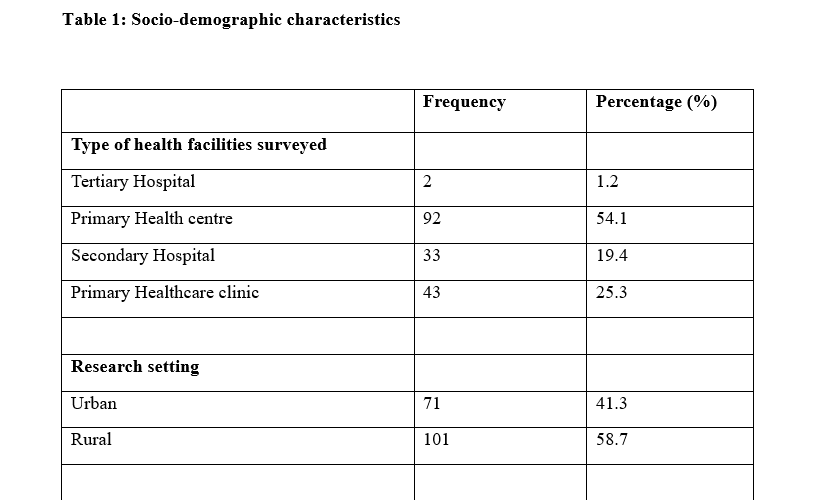
Facilities: 172 health facilities (132 government, 40 private) across six LGAs of Ondo Central Senatorial District, Ondo State, selected from 307 facilities listed in DHIS2. They included primary health centres, primary healthcare clinics, and secondary and tertiary hospitals in rural (58.7%) and urban (41.3%) areas.
Data collected:
A modified PRISM diagnostic questionnaire covering facility characteristics, HIS policy compliance and data quality
Facility NHMIS registers and source documents (registers, tally sheets)
NHMIS monthly summary forms submitted to the LGA, covering three months of confirmed malaria cases
Key Findings
Confidential (Not available to the public yet)
Impact
Confidential (Not available to the public yet)