Bush Meat Hunters' and Traders' Knowledge and Attitudes Towards Mpox in Benue State, Nigeria
Analysed data from a community-based cross-sectional study of knowledge and attitudes towards Mpox among bushmeat hunters and traders in Benue State, Nigeria. Data from 375 respondents, collected with an interviewer-administered questionnaire, were analysed in SPSS. The analysis scored knowledge and attitude levels and tested how they related to sociodemographic factors using chi-square tests. Of the respondents, 78.1% had heard of Mpox. Among them, 54.3% had good knowledge and 97.6% had a positive attitude. Hunters were much more knowledgeable than traders (72.1% vs. 40.2%, p < 0.001). The findings show that this high-exposure group is willing to learn and that health education should target it, especially traders.
Challenge
Mpox is a zoonotic disease, and bushmeat is one of its suspected reservoirs. In Benue State, bushmeat is regularly hunted and traded, often in rural communities, which puts hunters and traders at high risk of exposure. Little was known about what this group understood about Mpox or how they viewed its prevention. Gaps in their knowledge could allow spillover from animals to people and further spread. The analysis had to measure knowledge and attitude levels accurately in a population where many respondents had no formal education and interviews were conducted in Tiv, and identify which groups most needed targeted education.
Objectives
Find out how aware bushmeat hunters and traders are of Mpox
Measure their level of knowledge about Mpox, including its cause, transmission, treatment and vaccine
Assess their attitudes towards Mpox prevention and control
Test links between sociodemographic characteristics (sex, marital status, occupation) and knowledge and attitude levels
Provide evidence to guide targeted health education and zoonotic disease control
Methods
Knowledge scoring: 1 point per correct answer out of 11; 0–5 = poor knowledge, 6–11 = good knowledge
Descriptive statistics (frequencies and percentages) for respondent characteristics, knowledge and attitude
Chi-square tests of association between sociodemographic factors and knowledge and attitude levels
Significance level set at p ≤ 0.05
Data Sources
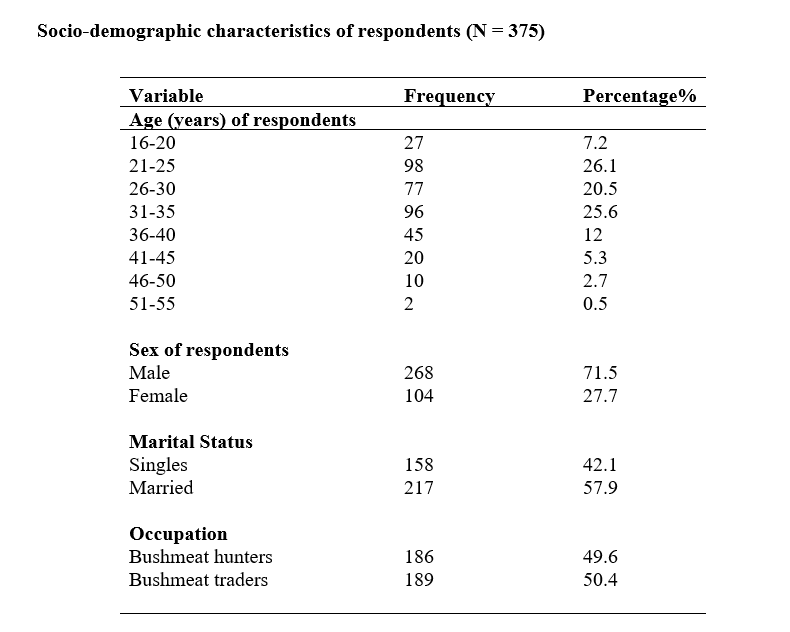
Primary data from an interviewer-administered questionnaire given to bushmeat hunters and traders across 18 wards in 6 randomly selected Local Government Areas of Benue State, Nigeria. Of the 415 people targeted, 375 responded (186 hunters and 189 traders). Questions covered sociodemographic characteristics, knowledge of Mpox and attitudes towards Mpox. Interviews were conducted in Tiv where needed. Ethical approval: University of Calabar, Department of Public Health (UC/CM/PUH/ETH/2302).
Key Findings
Awareness: 78.1% of respondents (293 of 375) had heard of Mpox.
Knowledge: 54.3% of those aware of Mpox had good knowledge, which is lower than the 58.7% reported among educated Nigerians in an earlier national survey.
Knowledge gaps: fewer than three-quarters knew about Mpox treatment (73.4%) or a vaccine (68.9%), and only 63.1% knew there are many human cases in Nigeria.
Transmission: 74.7% knew that contact with infected bushmeat can transmit Mpox, and 73.7% knew it spreads from animals to humans.
Occupation and knowledge: hunters had much better knowledge than traders (72.1% vs. 40.2%; χ² = 29.512, p < 0.001). This was the only significant link found.
Attitude: 97.6% had a positive attitude towards Mpox (hunters 96.9%, traders 98.2%). 94.9% wanted to learn more, and 96.2% agreed that mass media can help prevention.
Trust and fear: 86.3% trusted the Nigerian Ministry of Health and local communities to control Mpox, while 92.5% feared it could become a global pandemic.
No other significant links: sex and marital status were not significantly linked to knowledge (p = 0.391; p = 0.073) or attitude (p = 0.131; p = 0.873), and occupation was not linked to attitude (p = 0.479).
Impact
The study provides evidence on Mpox knowledge and attitudes among bushmeat hunters and traders, a high-exposure group that has received little research attention. The very positive attitudes and readiness to learn show that this group would be receptive to health education. The 32-point knowledge gap between hunters and traders shows that traders should be a priority. The gaps in knowledge about treatment and vaccines point to specific content that education programmes should cover. Strong support for mass media points to an effective way to reach them. Together, the findings support a One Health approach that works with hunters and traders as partners in preventing zoonotic disease.