Effects of educational intervention on knowledge, attitude and self-efficacy towards domestic violence prevention among married women in Taraba State, Nigeria
Carried out the baseline statistical analysis for a study on the effects of an educational intervention on knowledge, attitude and self-efficacy towards domestic violence (DV) prevention among married women in Taraba State, Nigeria. Using survey data from 248 married women, the analysis estimated how common DV was overall and in four forms (physical, psychological, sexual and financial). It also described what women thought causes DV and tested which sociodemographic factors were linked to it. Overall, 61.3% of the women had experienced at least one form of DV. The husband’s alcohol use and the husband’s level of education stood out as the factors most consistently linked to violence. These results set the baseline for designing the intervention and judging its effect.
Challenge
Before an educational intervention can be designed or evaluated, researchers need a clear picture of the problem it is meant to address: how common DV is, which forms are most common, and which women are most at risk. DV is often treated as mainly physical, which can leave psychological, financial and sexual abuse under-addressed. The analysis had to measure all four forms in one sample, test eight possible risk factors across five outcomes, and handle sparse categories (for example, very few husbands with postgraduate or no formal education) that make standard tests and regression models unstable.
Objectives
Find the overall prevalence of domestic violence and the prevalence of physical, psychological, sexual and financial violence among married women
Describe how women see the causes of domestic violence
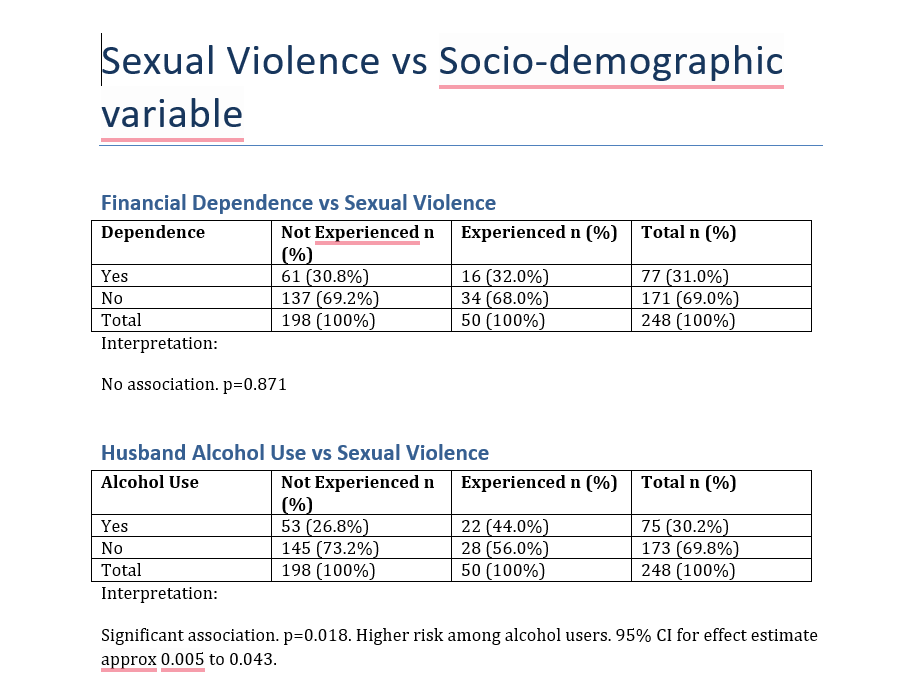
Test links between DV and sociodemographic factors: financial dependence, husband’s alcohol use and drinking frequency, wife’s and husband’s education, religion, type of marriage and age
Find out which factors independently predict DV experience
Provide baseline evidence to guide the content and targeting of the educational intervention
Methods
Descriptive statistics (frequencies and valid percentages) for perceived causes and DV prevalence
95% confidence intervals for proportions using the Wilson score method
Pearson chi-square tests of independence for each risk factor against each DV outcome
Fisher’s exact test for 2×2 tables and Fisher-Freeman-Halton exact test for larger tables with small expected counts
Monte Carlo simulation (10,000 samples) for exact p-value confidence intervals
Pearson’s r to measure the strength and direction of associations
Binary logistic regression (DV experienced vs. not experienced) with age, marriage type, religion, wife’s and husband’s education, alcohol use frequency and financial dependence as predictors
Model fit assessment using -2 Log Likelihood, Cox & Snell and Nagelkerke R², the omnibus test and classification accuracy
Significance level set at α = 0.05
Data Sources
Primary data from a structured questionnaire given to 248 married women in Taraba State, Nigeria. It covered sociodemographic characteristics (age, religion, type of marriage, wife’s and husband’s education, financial dependence on husband, husband’s alcohol use and drinking frequency), perceived causes of domestic violence (13 items), and experience of physical, psychological, sexual and financial violence.
Key Findings
Confidential (Result not made public yet)
Impact
Confidential (Result not made public yet)