Hepatitis B Vaccine Uptake and Seroprevalence
Analysed survey and screening data on hepatitis B virus (HBV) vaccination and infection among 370 healthcare workers across all 13 LGAs of Nasarawa State, Nigeria. The analysis estimated vaccination coverage and how many workers completed all three doses, identified factors linked to vaccine uptake, and measured HBV seroprevalence among the 333 workers who were screened. It also tested how vaccination related to infection. Methods included multivariable logistic regression, Firth penalised regression and propensity-score methods. Of the workers, 70.0% had received at least one dose and only 52.2% had completed all three, even though 91.8% reported knowing about HBV. Seroprevalence was 5.71%. Vaccinated workers had about 95% lower odds of testing positive (19.5% vs. 1.2% positivity). This result held across all sensitivity analyses.
Challenge
Healthcare workers have a high occupational risk of HBV infection, and a safe, effective vaccine exists. Even so, coverage among health workers in many Nigerian states is unclear, and the link between vaccination and infection is rarely measured at state level. The analysis faced several statistical problems:
Only 19 workers tested positive, out of 333 screened
Some occupational, educational and religious groups were very small
Standard logistic regression showed quasi-complete separation, which produced unstable, implausibly large estimates
The protective effect of vaccination had to be estimated robustly, with confounding properly handled and without relying on these unstable model estimates.
Objectives
Estimate how many healthcare workers in Nasarawa State have received the HBV vaccine
Measure completion of the full three-dose series
Identify sociodemographic and occupational factors linked to vaccine uptake
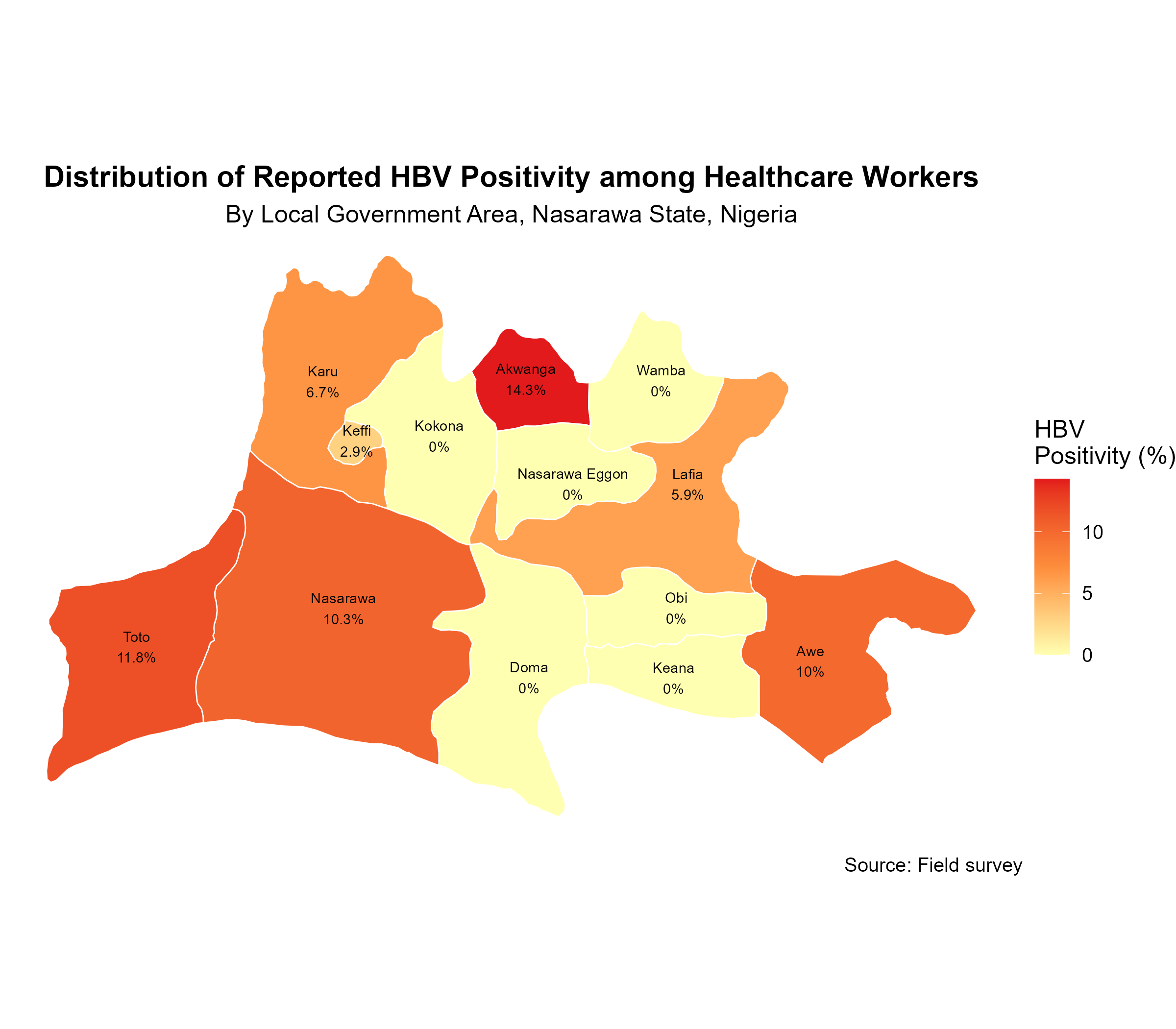
Estimate HBV seroprevalence among healthcare workers and show how it varies by LGA and occupation
Assess the link between vaccination status and HBV positivity, adjusting for confounders
Look at whether the number of vaccine doses received is related to HBV positivity
Compare HBV knowledge with actual vaccination uptake
Methods
Descriptive statistics: frequencies and percentages for sociodemographic characteristics, vaccination status, and dose completion
Prevalence estimation: vaccination coverage and HBV seroprevalence, each with 95% confidence intervals
Stratified prevalence: HBV positivity broken down by LGA and occupation
Determinants of uptake: binary logistic regression, reporting unadjusted (OR) and adjusted (aOR) odds ratios with 95% CIs, adjusted for age, sex, occupation, education, experience, religion, LGA and HBV knowledge
Vaccination and infection:
Cross-tabulation and unadjusted odds ratio
Multivariable logistic regression adjusted for age, sex, occupation, education and experience
Sensitivity analyses to address separation and confounding:
Firth’s penalised logistic regression
Propensity-score matching
Inverse probability of treatment weighting (IPTW)
Dose-response analysis: HBV positivity by number of doses received, with the odds ratio per additional dose
Model diagnostics: identified small cell counts and quasi-complete separation, and left unstable estimates out of the reported results
Spatial visualisation: choropleth map of HBV positivity across the 13 LGAs
Data Sources
Survey: structured questionnaire answered by 370 healthcare workers across all 13 LGAs of Nasarawa State, Nigeria. It covered:
Sociodemographic and occupational characteristics
HBV knowledge
Vaccination status and number of doses received
Screening: HBV serological screening results for 333 of the workers
Key Findings
Not made public yet
Impact
Not made public yet